Candid Search — one platform for the sector's most comprehensive nonprofit and funder data.
Candid holds the most complete, most trusted data about the social sector. The challenge: design a single search experience that makes that data feel accessible — serving four distinct user types, reconciling two merged product legacies, and keeping the design consistent across multiple feature teams.
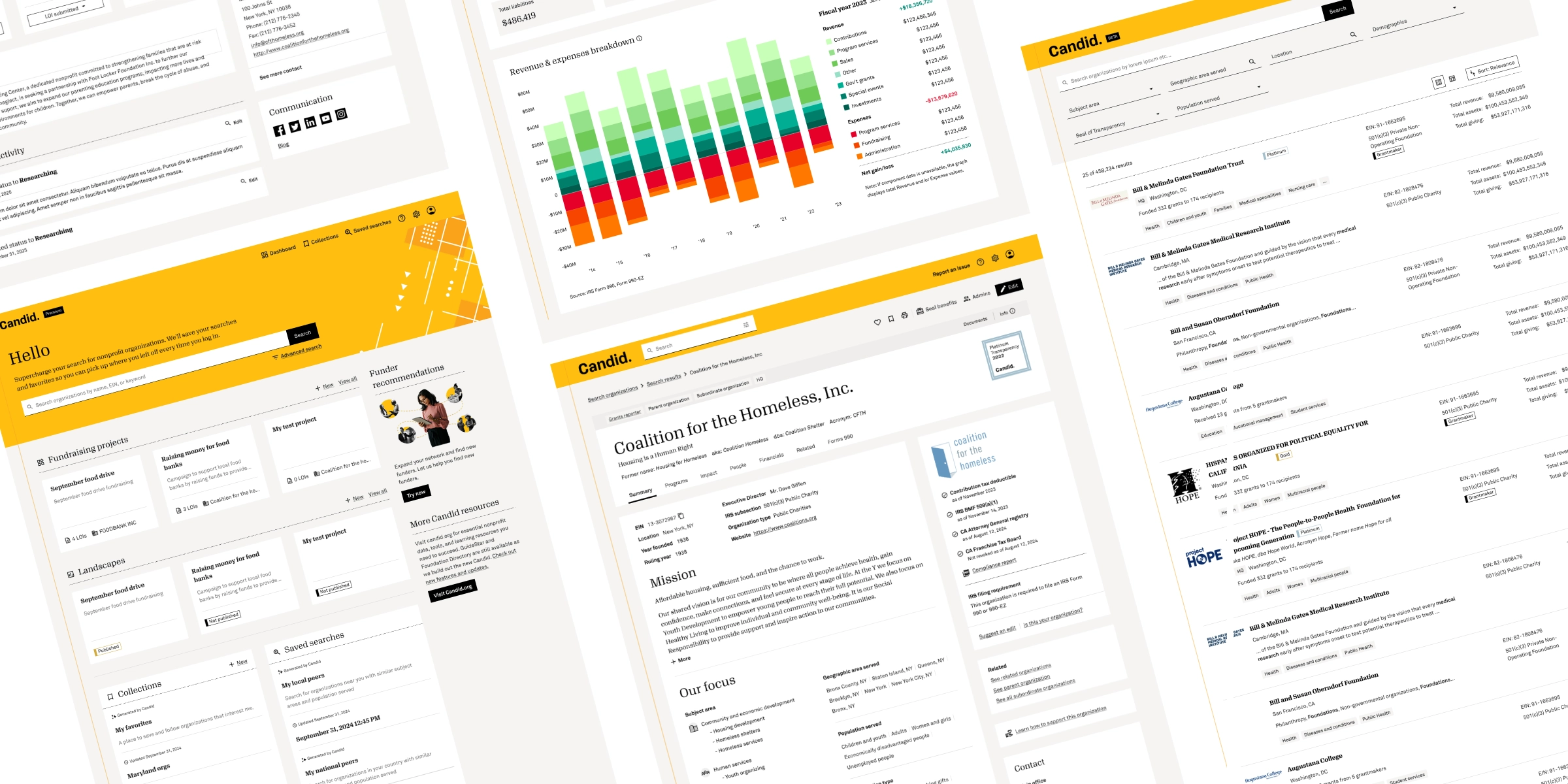
The most comprehensive data about the social sector. One platform to access all of it.
No organization holds more complete, more trusted data about nonprofits and philanthropy than Candid — 1.9 million organization profiles, 30 million grant records, $180 billion in annual grants tracked, and 2,500+ data points per organization. That data came from two separate product legacies: Foundation Center's grant database and GuideStar's nonprofit transparency platform. Unifying them required rethinking everything.
Design direction and IC work — across the whole product, not a slice of it.
As Design Director & IC at Candid, I held both the strategic and the hands-on. I set design direction, shaped product decisions alongside PMs and engineering leads, and contributed directly to the work — from early concept sketches through final UI. In a scaled agile environment with multiple parallel feature teams, my most important contribution was systems thinking: maintaining coherence across a product that could easily fragment into disconnected pieces.
In a scaled agile environment, feature teams go deep — and that depth is exactly the problem. A team designing the filter system doesn't feel the downstream effect on how a funder reads a result card. A team building AI recommendations doesn't see how the new feature interacts with the existing saved-search workflow.
My role was to hold the whole product in view while each team held their piece. That meant being in enough conversations to spot when two teams were making incompatible assumptions — and intervening before those assumptions became shipped code.
Cross-team engineering dependencies were one of the most significant friction points in the build. When the compliance data surface depended on a separate team's API work, design decisions had to account for what could ship incrementally vs. what required the whole stack to be ready.
I worked closely with engineering leads to understand dependency chains early — designing modular, gracefully degradable UX that could ship something useful before all dependencies resolved, rather than blocking on the full feature. This shaped the phased rollout strategy and reduced the risk of a single team's delay cascading into product-wide slippage.
Four personas. Four fundamentally different relationships with the same data.
Working alongside our embedded UX researcher, I led the synthesis of qualitative interviews and survey data into four actionable personas. Each shaped a distinct set of design requirements — and the tensions between them defined the hardest decisions in the product.
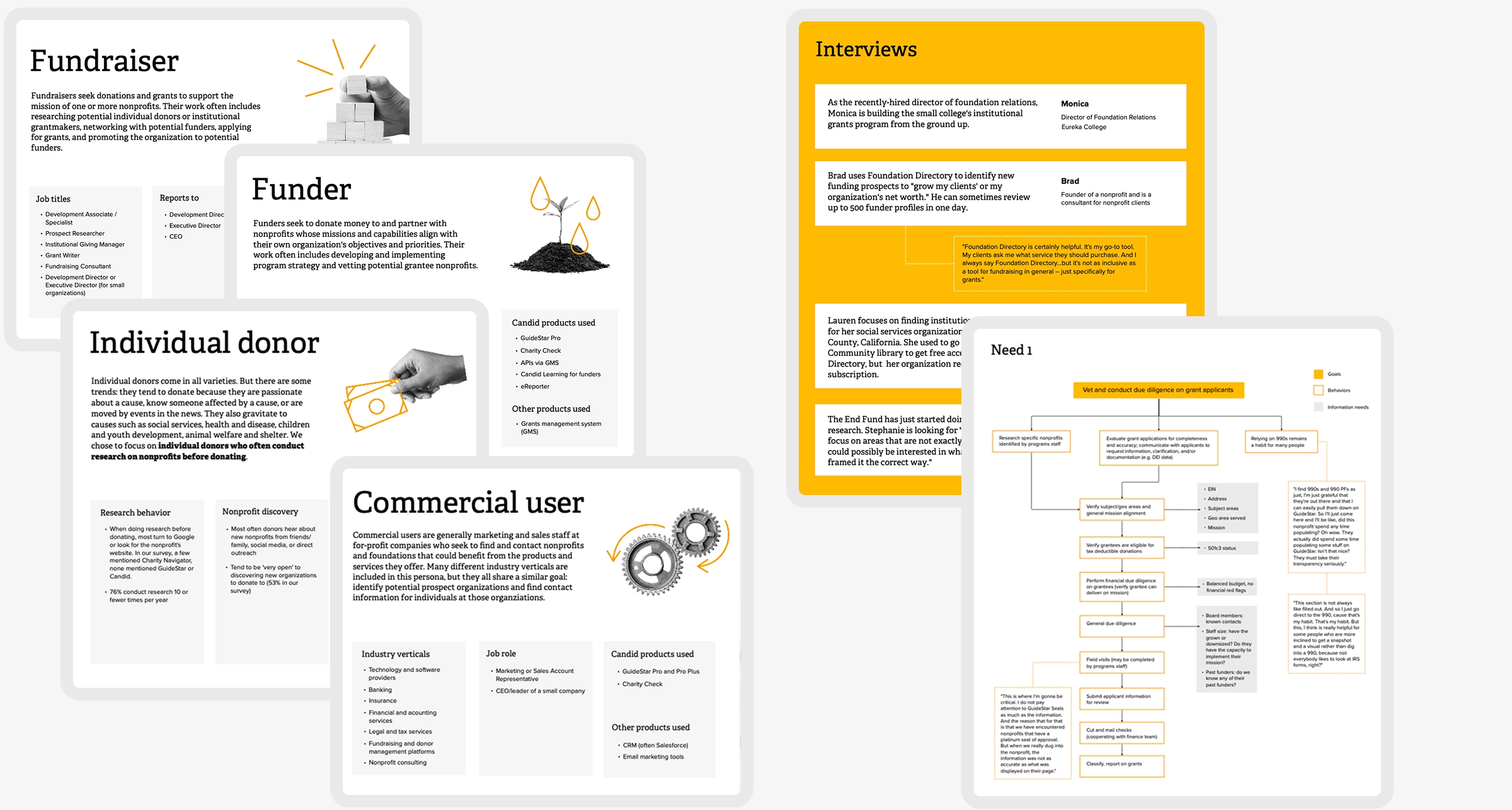
"When users are looking for a specific nonprofit, they want name matches at the top of results. When they want to discover new organizations, they want to match other profile data and easily filter results."
This research insight shaped the entire information architecture of search results. We couldn't optimize for one intent without degrading the other — so we built dual-mode search logic, surfaced through the UI.
Mapping the paths through complex data.
With four distinct personas and two merged data sources, we mapped user flows to surface where the legacy products created friction — and where unification created new design opportunities. The flows below represent the two highest-frequency journeys in the platform.
The core use case for Foundation Directory users. A development professional researching funders needs to move fluidly between discovery, deep-dive profiling, and prospect list building — often in a single session reviewing 50–500 funder profiles.
Foundation program officers and grants managers use Candid as part of their compliance workflow. Speed matters — they often need to verify multiple applicants quickly, and data accuracy is non-negotiable.
From structure to surface.
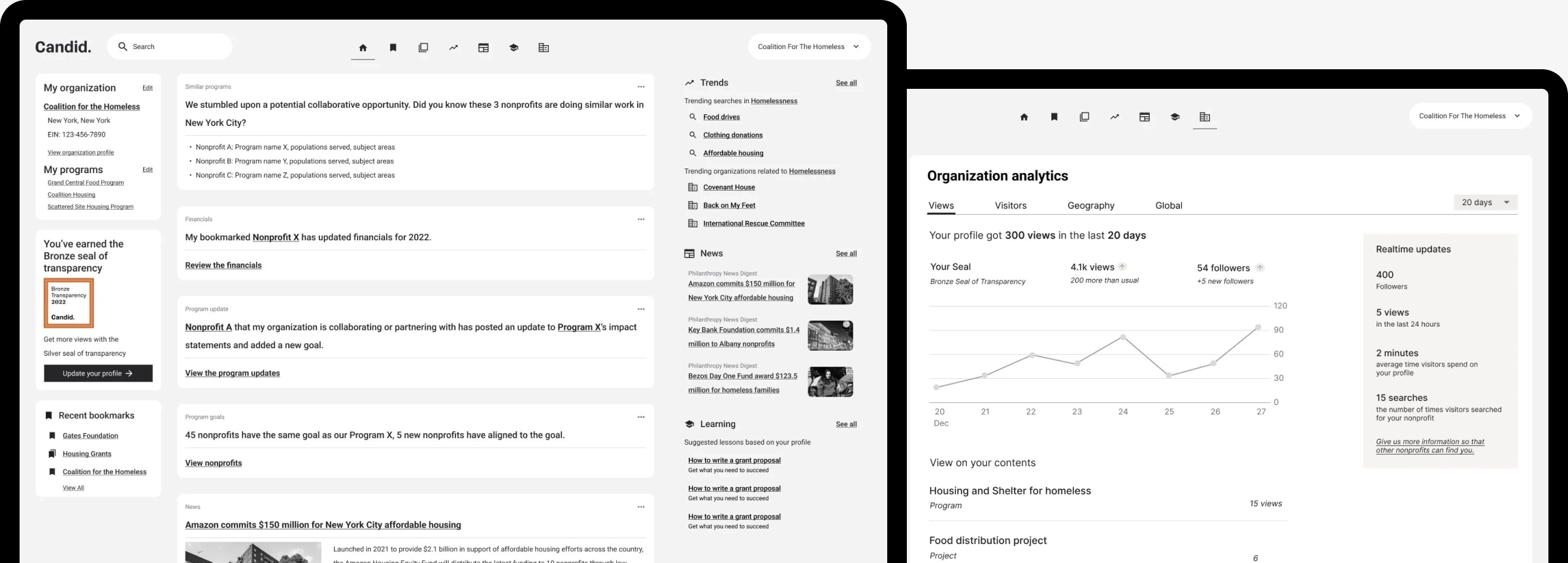
Low and mid-fidelity wireframes mapped the core search surfaces before high-fidelity work began — establishing information hierarchy, filter placement, and result card structure across the two primary use cases.
The decisions that shaped the experience.
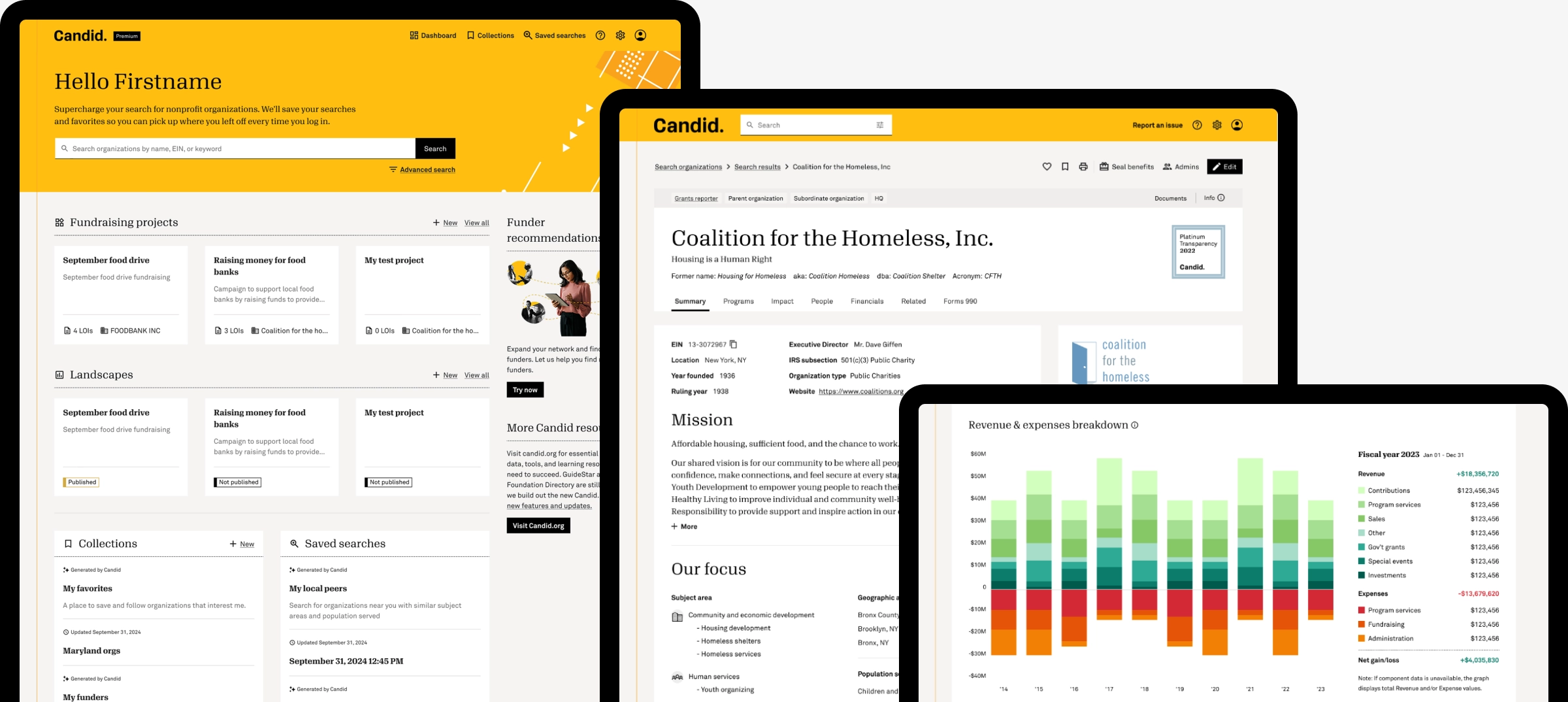
Every significant design decision in Candid Search had a corresponding tension to resolve. These are the ones that mattered most — and why we made the calls we did.
Designing the AI features — acceleration without abdication.
Unification unlocked a new class of features that weren't possible with separate data sources. With 3 million+ grant transactions and 1.9 million org profiles as a unified graph, we could build recommendation systems that genuinely understood the relationship between funders and grantees — not just surface static search results.
What shipped — and what it means.
Candid Search launched in January 2026 as the first unified search experience for nonprofit and funder data in the social sector. The platform positions Candid as the authoritative data layer for the emerging AI ecosystem serving nonprofits.
"At a moment when nonprofits and funders are navigating uncertainty and growing complexity, access to clear, reliable information matters more than ever. The new Candid search brings together the data and tools people already trust into a single, more intuitive experience."
— Ann Mei Chang, CEO, Candid · January 2026